-
All I can say at the moment Is how glad I am that I was lucky enough to decide not long ago to get into this area, and begin the process of education to work in this field at such an exciting and developing moment. Craig I just noticed no one has asked where your from if you don't mind? -
Just when I thought it was safe to go away on holiday............
Firstly (as little as an endorsement by me actually means!), I can with a high degree of confidence say, that the spider in the pictures is the "Arana Pollita" or Chicken Spider that I have come to know very well after my 6 trips to the region.
Secondly, May I wish Craig congratulations on being the first to successfully replicate the communal ethology of Tambopata's big Pamphobeteus in captivity - something that many people refused to believe when I first wrote about it a few years ago. The poisoned e-mails still turn up whenever "Deep Jungle" gets aired on TV!
Thirdly, I know the true controversy is always going to be the identification and I can only relate what I know and trust in this regard, namely;
Andrew Smith keyed out the dead preserved specimen that I obtained from an American researcher with permission to remove material from the Candamo Tambopata Reserve. This adult female (now in the NHM London) was compared to all the large Theraphosid families in South America.
The specimen was confirmed by Andrew as a member of the genus Pamphobeteus, however it was suitably different from the type specimens of all know species to be considered something new. Its closest "match" was actually not to P.antinious but to P. negricolor (itself sometimes considered synonymus with P.insignis! just to make things even harder)
IS this the "true" P. antinious? is this a regional P. negricolor? or is it a new species? I honestly don't know.
The fact is that with this fascinating, fantastic tarantula now being captive bred, its true identity will soon be confirmed.
My thanks and congratulations again to Craig, I think the legacy of this species that is so close to my heart is in good hands!Leave a comment:
-
Leave a comment:
-
Kudos to you, Craig!
You have given us a fascinating thread, answered the constructive questions thoroughly, and even handled the thinly veiled sarcasm like a gentleman - can't wait to learn more!!
Leave a comment:
-
Ok ,fair enough, so whos going to do the dirty work and compare my dead male CS and work out once and for all its identity. If I gave you that would you be able to do it?
Cheers
Craig
Originally posted by Richard Gallon View PostLast edited by Craig Bellamy; 05-07-07, 10:07 AM.Leave a comment:
-
And who's to say that what's in captivity really is P. antinous?
You can't ID a species by comparing it against captive material which just happens to be called "antinous" by a dealer. Most dealer IDs are guesses anyway.
The ONLY way to check is to compare your male against Pocock's original type specimen (male).
You may just discover that the stuff in captivity isn't the same as what Pocock described, and that it's the same as the CS (remember Pocock didn't have a female to examine; and Andy only had a female CS to compare against Pocock's male). You need to compare like-with-like to be certain!
In taxonomy you have to check and double-check all possibilities. Never take anything which has been said or published before as the absolute truth.
New to captivity is not the same as new to science.
Cheers,
RichardLeave a comment:
-
Hi Todd,
Thanks for your comments. Well, here goes. In my humble opinion, it is definitely not a P.antinous variant and here are my reasons why
1) Nobody here has reared from nymph to adult and further bred a CS.
I have.
2) few here have even visited Tambopata and seen one.
I have.
3) We all know that it is bad practice to identify a T but by an image alone, no matter how experienced you are.
4) No one to my knowledge has seen a male CS.
I have and bred one too.
taken from Manu national park (not my image so can not confirm it is the CS male though looks similar to mind...again means little unless in the flesh)
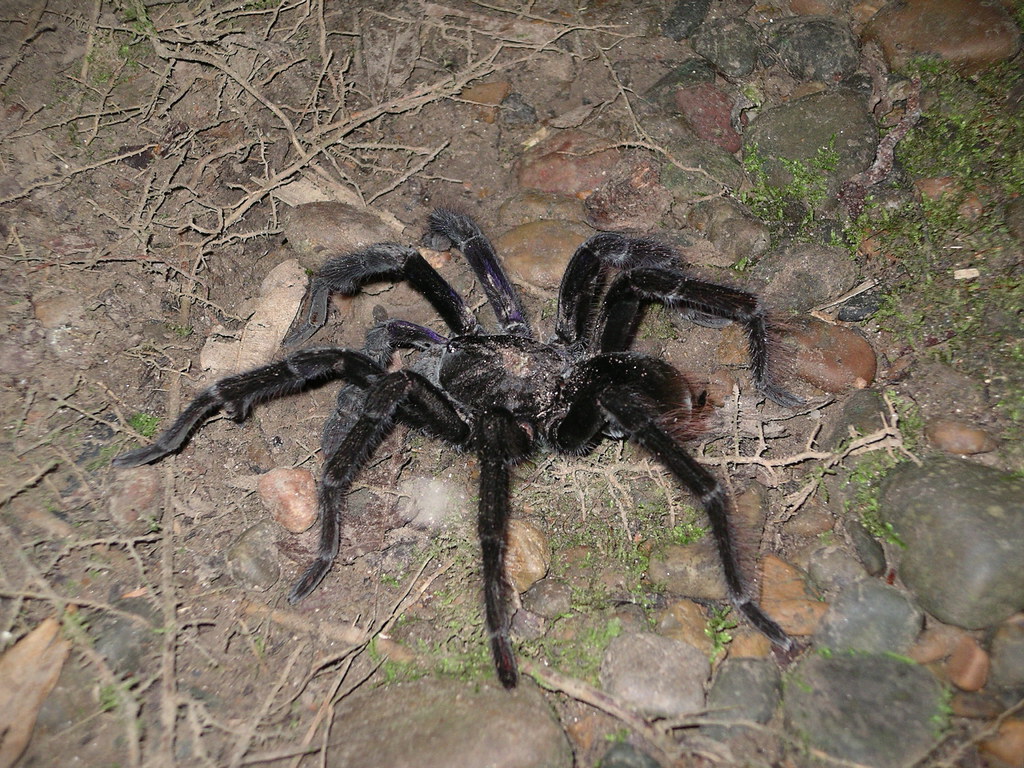
5) The communal habits of P.antinous are non-existent compared to those of the CS. Try it yourself, oh and goodluck! There are many many pictures of CS spiderlings in the wild in large gatherings, yet I have never seen P.antinous pictures like this and there are a lot more P.antinous pictures.
6) The difference in adults side by side are astounding, I wish I had an adult P.antinous here to show you. The P.a is fairly hairy and slender as you say. Much darker in colour, being black/grey.
The CS is much chunkier like a crab, especially the femur of the fourth legs. In fact all femurs are chunky. The carapace is wider in proportion too. The CS is a lot less hairy which gives it a silky appearance and with lovely rusty coloured hairs on the rear of the abdomen and on the chelicerae as well as lightly all over and the under section of the cephalothorax. Images in the forest that have little light make the spider look black, but in fact the spider is a rusty/dark grey and lighter before a moult. See my pictures below.
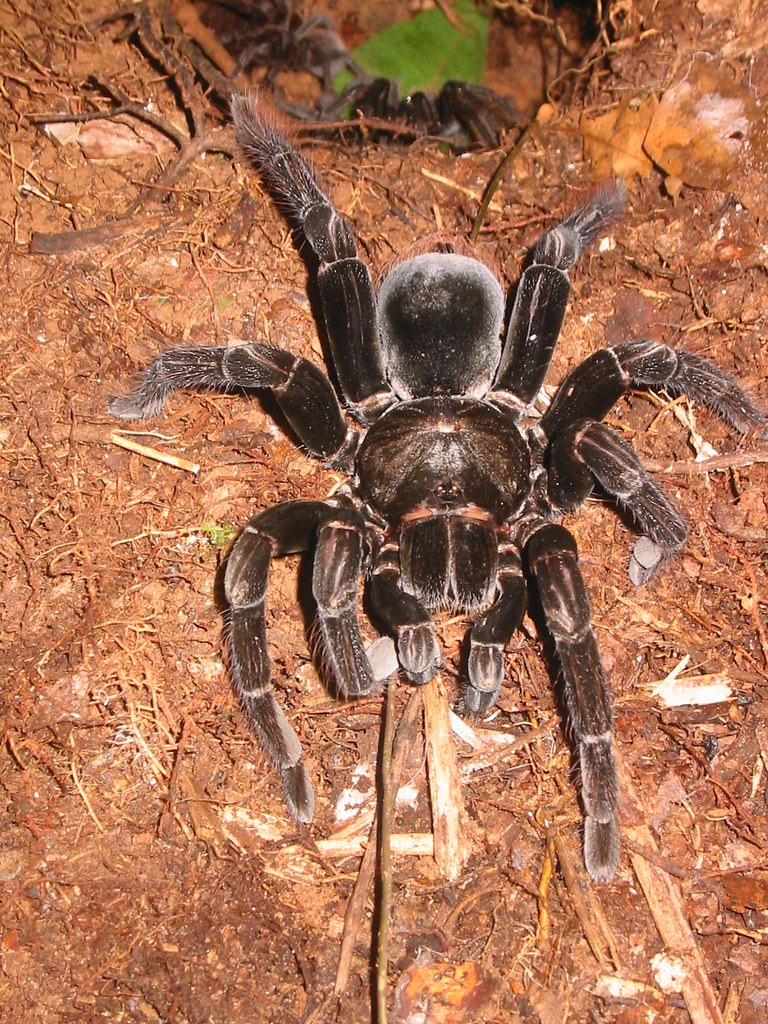
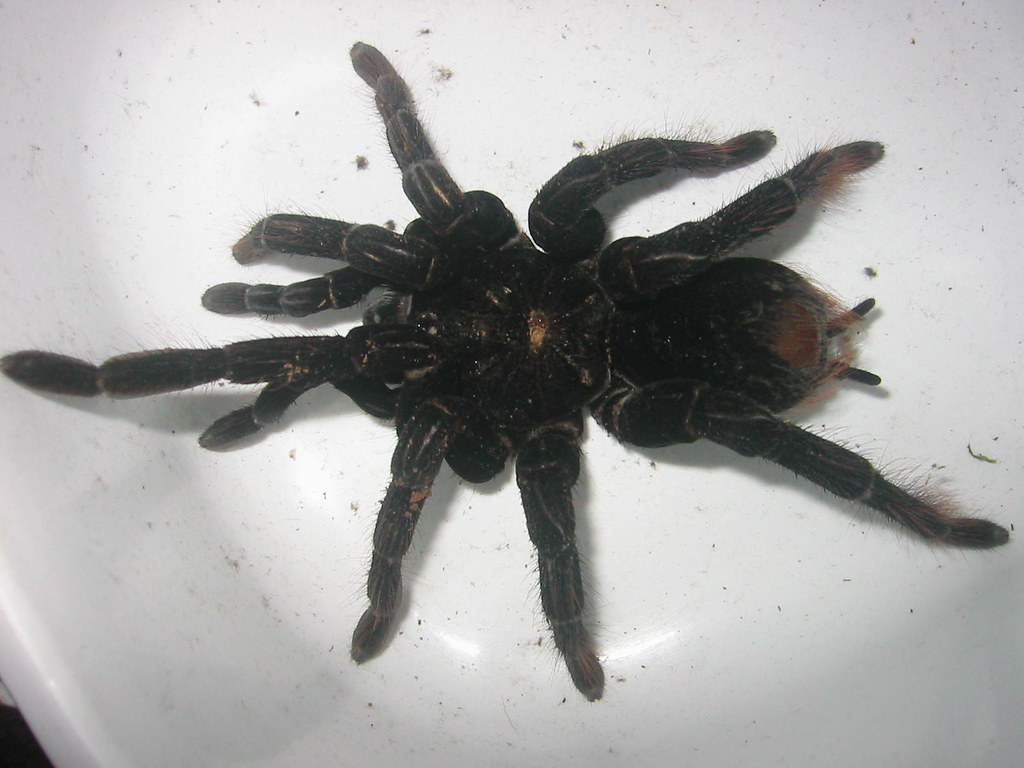
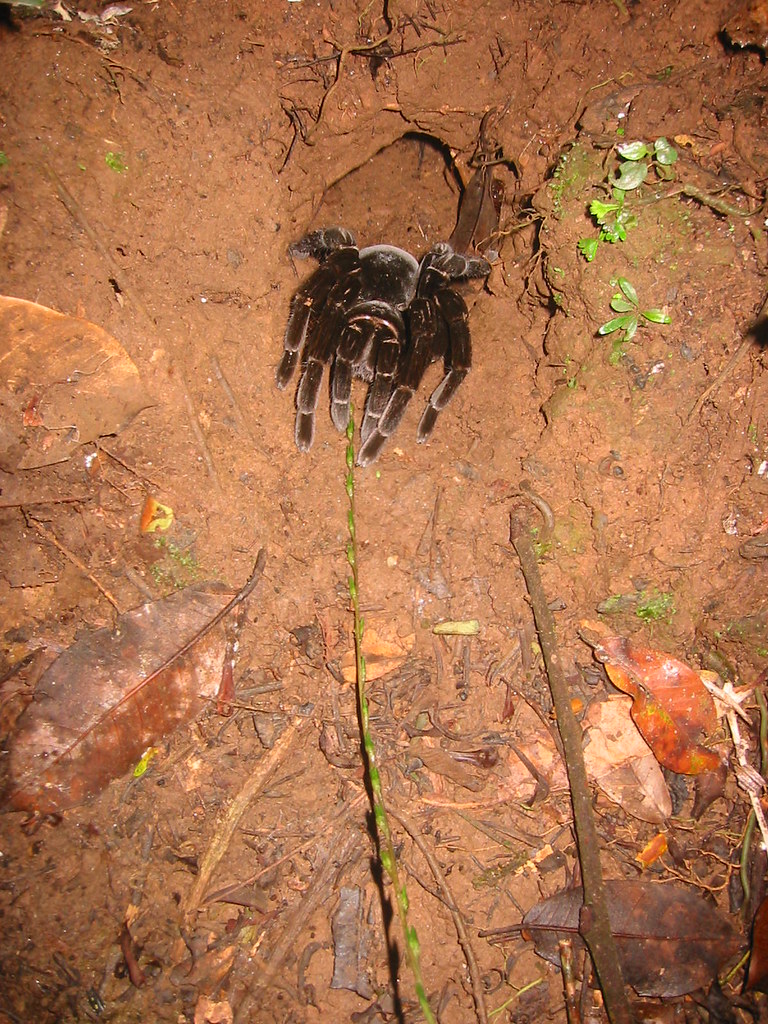
7) Last but not least, The P.antinious spiderling shares absolutely no resemblance in colour, shape and character to that of a CS.
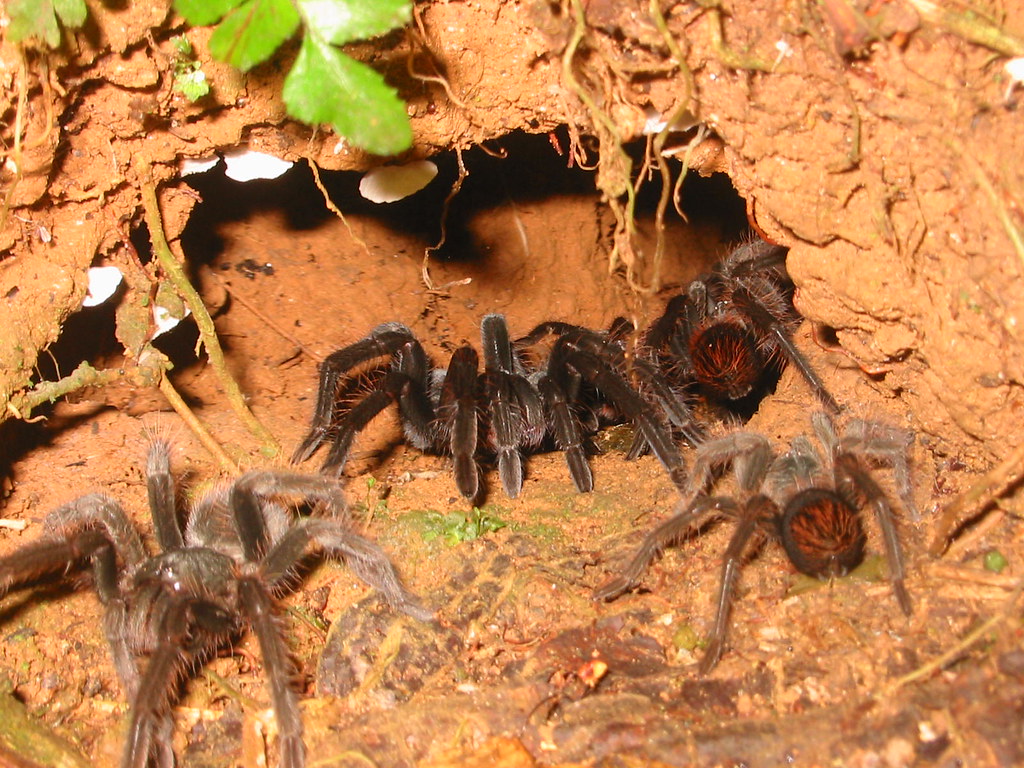
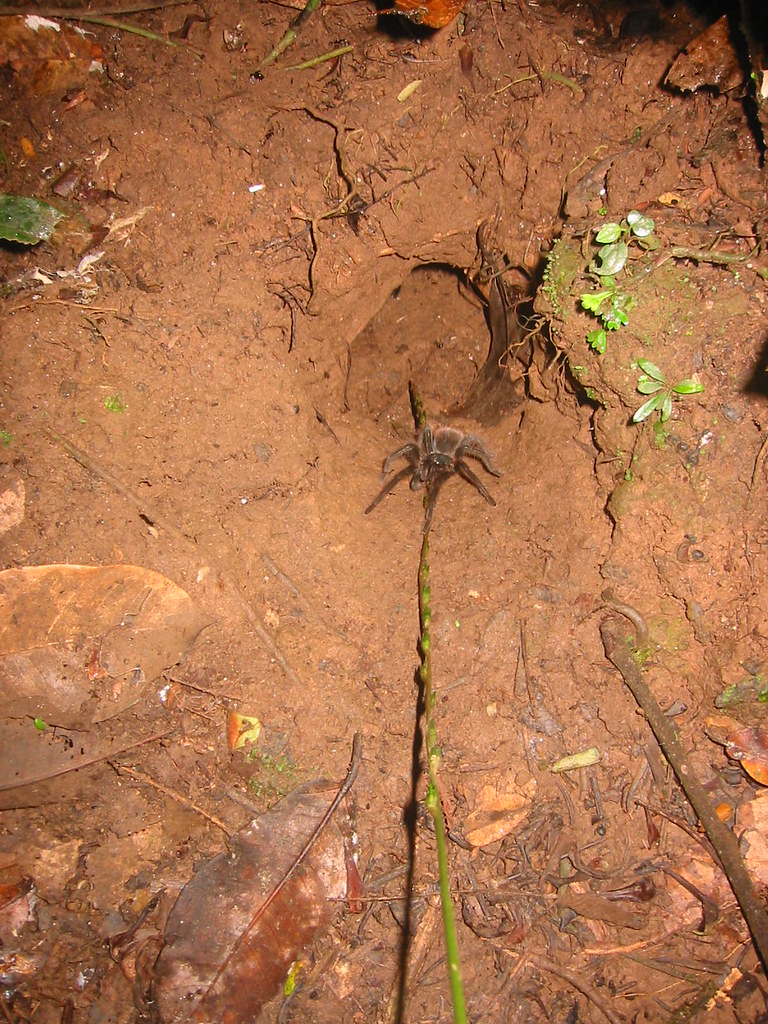
If everyone here had the privilege of looking after this wonderful species, you'd know, these are no ordinary T's. We have something very special here. I say, don't listen to anyone, go see for yourself. Martin and I are insistent that these are completely unique.
Incidentally, while nosing around on flickr after posting my photos I found this
http://www.flickr.com/map/?&user_id=...0&map_type=hyb
Click on 34, then scroll the thumbnails to 12 of 34.
Recognize the brown tarantula in the middle? a T.blondi? can't be? in Madre De Dios? worth querying...
http://www.flickr.com/photos/sequella/424152855/
Regards
Craig
Originally posted by Todd Gearheart View PostLast edited by Craig Bellamy; 05-07-07, 03:37 AM.Leave a comment:
-
southern variant of P. antinous
I have long been a Pamphobeteus collector since the early 1990's and have kept, bred and seen many different species in this genus. I have to side with Rick West for now and say this "Chicken Spider" is most probably a geographical variant of P. antinous. If I remember right in a communication exchange I had with him in the late '90s, he mentioned that the P. antinous in S.E. Peru (specifically the Madre de Dios region) was much bigger than the P. antinous of central-eastern and NE Peru (Iquitos region), and he also said the mature males are a real steel blue" coloration in their femurs than the northern variant which tends to be more purple-blueish. I have seen thousands of the Pullcapa, Peru and Iquitos, Peru P. antinous. They tend to be very nervous, high-strung and do not do well in confined areas. They averaged 8" in older females with males maturing at 5.5"-7.5" legspans. They were also very slender-legged similar to P. vespertinus.
These "Chicken Spiders" from S.E. Peru have the typical P. antinous look: jet black to gray to brown (pre-molt) with the rear half of the abdomen possessing fiery red to reddish-brown hairs. The only two appearance differences that I see are they are more thick-legged and get a littler larger in size. As for the communal behavior, that might exist in the whole genus. I suspect many Pamphobeteus breeders have not experimented with trying to keep them long-term communally due to their high value and the fact that they dont' have 600-2000 spiderlings like some genera.
In summary, I put for the idea that this S.E. Peruvian Pamphobeteus is most probably a southern variant of P. antinous and not a distintct species until a theraphosid taxonomist can study them and determine if they are indeed a new species in the genus. It's an ole argument between the "lumpers" and "splitters". I go with the lumpers. Lastly, I think more Pamphobeteus breeders should experiment with raising the young up communally and see if other species in the genus are like these "chicken spiders". For now, I would list the spider under the following name:
Pamphobeteus sp. "Tambopata" (poss. variant of P. antinous) and to p** everybody off with common names useage, we can call it "Giant Black Sloth-eating Spider".
Todd
www.tarantulaspiders.comLeave a comment:
-
[QUOTE=Craig Bellamy;15198]Thanks RayOriginally posted by Craig Bellamy View Post
Uniform dark grey at L1. [QUOTE]
What is L1 (do you mean LEG1lol)? this is not a term I am familiar with in regards to development? In your picture of the eggsac the stage of development are larvae/N2 the developmental stage before what we call a spiderling do you mean that spiderlings are dark grey?
[QUOTE] I doubt they swim, nothing like Hysterocrates. [QUOTE]
I was wondering, I always thought 100% humidity was virtually pure water, so when you were talking about 100% humidity I thought that you meant they were in that part of the forest that floodes as you see on TV? If they were flooded then that would give an indication to the climatical trigger for either mating, eggsac production, spiderling dispersal etc, a sort of "wetter" season in a humid climate, or do they have a drier season mate.
I like the quality of your information, almost giving a GPS site LOL, It wouldnt surprise me that some people (comercial collectors) after seeing your pictures and reading your locality information, wont be checking out flights already, and going to get a bunch to sell in the pet trade, I heard a rumour someone was trying to get a project going to get these farmed by the local indians as a source of income, did youhear anything of this?I was in Peru last year, in Tambopata, after Machu Picchu from Cuzco to Puerto Maldanaldo. An amazing transition within 10 minutes flight, barren scrubland to deep thick rainforest.
Found the same spiders in a matter of minutes from camp. Unmistakable in look and character and identical to mine, I didn't need to go there to see that, just looking at everyone's holiday snaps of this spider confirmed it, I just wanted to see them in the wild. One thing about this T is it is on par with blondi in terms of individuality. You can identify it from a mile off, very chunky like a blondi, if not more. Velvet black look with firey red hairs on abdomen.
One thing surprised me, I found a few burrows with no apparent adult and just spiderlings of a reasonable size (3”). They sit outside in dozens waiting for prey at quite a distance from the burrow above and below up to a meter away and dart in when disturbed. Wave straw at them and they all jump on like children on an assault course. Craig
From your earlier posts you are very sincere in your efforts to have these bred asap to fill the captive requirements for the pet trade (sorry i cannot help I will be leaving the UK in a few months, no I wont be in Peru mate ), I was wondering as you are so keen to get these kicked of in captivity when you say "distributed" will you be giving the young away free to experianced people rather than cashing in on them? Well done!
I am working on a similar project with the almost extinct Poecilotheria smithi and (my share of) the young from the eggsac laid last Saturday will be freely shared out amongst experianced keepers for establishing a joint BTS and Danish Breeding group.
Like you I can see when finacial renumerations from an endangered species cease to be the number one priority and establishing a strong captive colony takes priority mate.
If you dont mind another couple of questions, there are some other people I have talked to wondered the same thing, so kill two birds with one stone so to speak LOL mate.
The dealer you got yours from mate, was he selling them individually or in groups? just wondering if you care to mention his name and when you got them then maybe if anyone else got them from the same dealer this would enlarge the captive population for your goal of getting these established quickly in the hobby so making it less worth while for commercial collectors to go for them? Also if the dealer was selling them singally how did you work out that they could be kept together? considering that they are not yet classified mate what gave it away? your scientific expertise here can help other people make sure they have the correct males for any possible females they might have bought from the same dealer?
If you call the first picture No 1 etc, pics no 10 and 12 (the first one after the eggsac pic) are they the same spider? Just wondering as they both seem to have the same light coloured forest soil in the foveal groove, but the spider in pic 10 looks like it is in a container of some sort, were you also doing some research on them mate? weighing them etc? As I will be doing something similar when I move to Central America maybe we could swap notes, you know mate the best weighing scales, holding containers etc for collecting the big stuff, if you were working on them that is Mate.
You said this is not one of the Pamphobeteus sp you have bumped into, how do they differ scientifically from the big black Pamphobeteus sp sold in the 90s by Ian Wallace as P. antinous? ( i doupt if anyone would even have a picture of these anymore never mind a specimen, but these were huge blondi sized black spids. I know your ones are not the same is the small things sold as P. antinous today with the purple males, also how do they differ from the other species of Pamphobeteus you have bumped into? (scientifically not just social, chunkier etc) what are the hairs on the carapce like in structure compared to other Pamphobeteus sp? do the hairs on the abdomen point back over the carapace like P. petersi as Mikhail has mentioned?
Any structural help you can give would help other people know if they have this species from the same dealer.
Thanks for your time mate, hope you dont mind all the questions, but its not just me who is curious.
Later and thanks again
RayLeave a comment:
-
Thanks Ray
Uniform dark grey at L1.
I doubt they swim, nothing like Hysterocrates.
I was in Peru last year, in Tambopata, after Machu Picchu from Cuzco to Puerto Maldanaldo. An amazing transition within 10 minutes flight, barren scrubland to deep thick rainforest.
Found the same spiders in a matter of minutes from camp. Unmistakable in look and character and identical to mine, I didn't need to go there to see that, just looking at everyone's holiday snaps of this spider confirmed it, I just wanted to see them in the wild. One thing about this T is it is on par with blondi in terms of individuality. You can identify it from a mile off, very chunky like a blondi, if not more. Velvet black look with firey red hairs on abdomen.
One thing surprised me, I found a few burrows with no apparent adult and just spiderlings of a reasonable size (3”). They sit outside in dozens waiting for prey at quite a distance from the burrow above and below up to a meter away and dart in when disturbed. Wave straw at them and they all jump on like children on an assault course.
Craig
Originally posted by Ray Gabriel View PostLeave a comment:
-
Nice find Andy. Just as all pet shops in the UK have suddenly been emptied of live mice
Originally posted by AndyM View PostLast edited by Craig Bellamy; 04-07-07, 08:23 PM.Leave a comment:
-
Plan to send you a nice reply but first a couple of quick questions:
What colour are the spiderlings? that is what group do they come from, the plain ones or the Xmas tree ones. By spiderlings I mean after they have moulted from Larvae?
Do these spiders swim?
When were you in Peru?
RayLeave a comment:
-
Hello,
FYI.
The 1911 act which is refered to in this thread is now out of date due to the 2006 animal welfare act.
Therefore any reference made to this act is irrelevant. I think if you look closely at the new act it would be found that the feeding of live vertibrates as prey is illegal unless you can prove suffering would occur by not doing so.
Please correct me if I am wrong.
Regards.
Andy.Leave a comment:
-
Craig If you look in the thread "T's on Youtube?" By Glen Feasey started on 04-07-07 02:28 PM.
You need to then find the post by Simon.
I have added a reply to that thread which has pulled it back to the top of the forum topics.Leave a comment:
-
Could you be more specific about these posts by giving links etc
Originally posted by J M Clegg View PostLeave a comment:

- If this is your first visit, be sure to check out the FAQ by clicking the link above. You may have to register before you can post: click the register link above to proceed. To start viewing messages, please register with your real full name as per the rules and regulations, select the forum that you want to visit from the selection below.


Leave a comment: